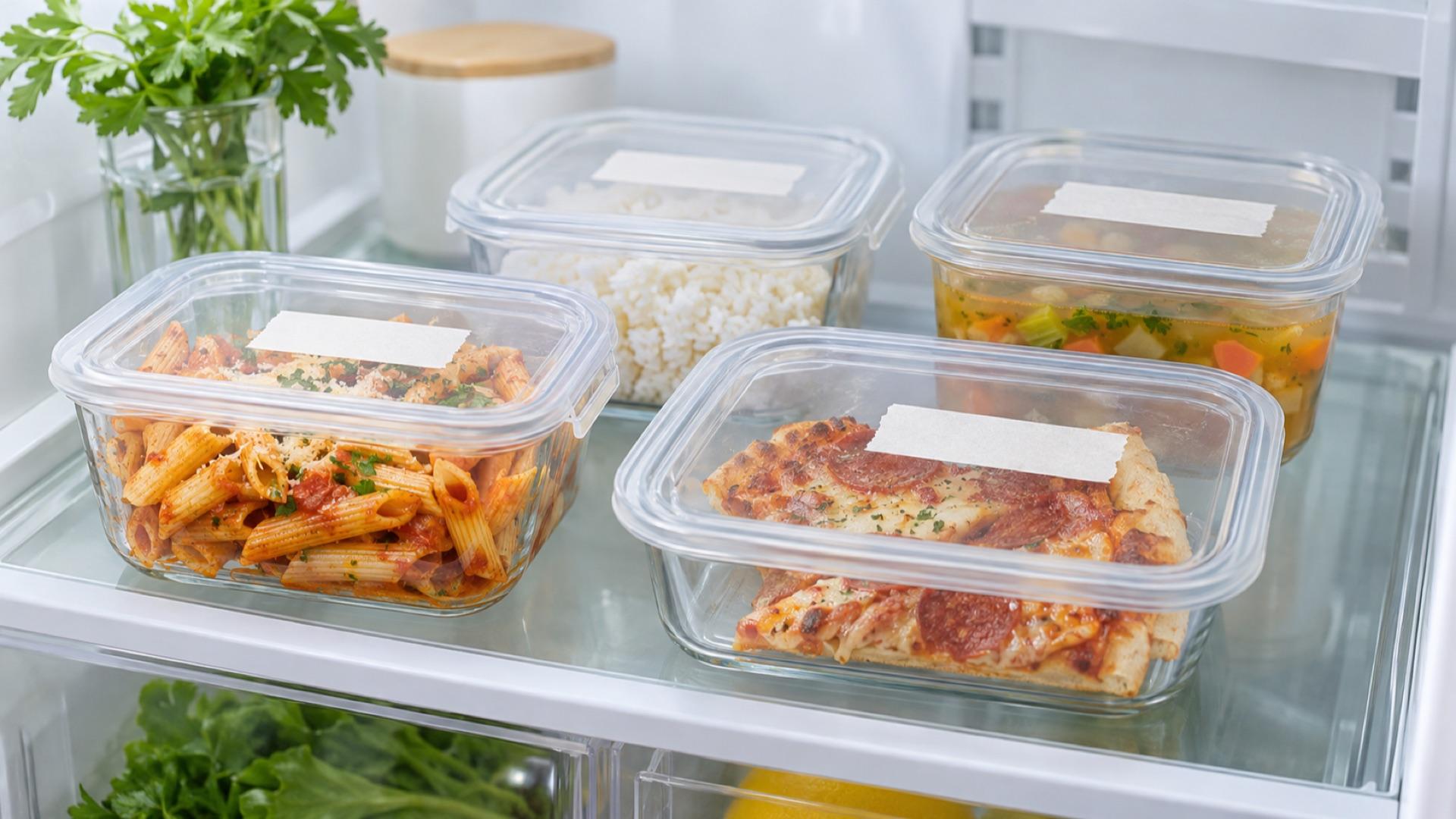
Most cooked leftovers last 3 to 4 days in the refrigerator at 40°F (4°C) or below, according to the USDA Food Safety and Inspection Service (FSIS). That rule covers pizza, cooked meat and poultry, rice, soups, casseroles and most takeout, with a few exceptions such as cooked pasta (up to 5 days) and hard-boiled eggs (1 week).
The bigger risk is usually not day 4 itself but forgetting which day it is. This guide gives you a food-by-food chart, the 2-hour rule that decides whether leftovers are safe to keep at all, and simple ways to store, freeze and reheat them.
Leftovers Storage Chart
All refrigerator times assume a fridge at 40°F (4°C) or below. Freezer times are for best quality at 0°F (-18°C); frozen food stays safe indefinitely.
| Leftover | Refrigerator | Freezer |
|---|---|---|
| Cooked meat or poultry | 3 to 4 days | 2 to 6 months |
| Rotisserie chicken | 3 to 4 days | 4 months |
| Cooked fish and shellfish | 3 to 4 days | 1 to 3 months |
| Pizza | 3 to 4 days | 1 to 2 months |
| Cooked pasta | 3 to 5 days | 1 to 2 months |
| Cooked rice and other grains | 3 to 4 days | 1 to 2 months |
| Soups and stews | 3 to 4 days | 2 to 3 months |
| Casseroles with eggs (after baking) | 3 to 4 days | 2 to 3 months |
| Quiche | 3 to 5 days | 2 to 3 months |
| Cooked vegetables and potatoes | 3 to 4 days | 1 to 2 months |
| Egg, chicken, tuna, ham and macaroni salads | 3 to 4 days | Does not freeze well |
| Hard-boiled eggs | 1 week | Do not freeze |
| Pumpkin or pecan pie | 3 to 4 days | 1 to 2 months |
Sources: the FoodSafety.gov Cold Food Storage Chart and the USDA FoodKeeper. The FSIS leftovers guidance gives frozen leftovers 3 to 4 months in general, while the FoodKeeper lists shorter ranges for specific dishes; the table uses the more specific number.
The 3 to 4 Day Rule
FSIS states it simply: leftovers can be kept in the refrigerator for 3 to 4 days or frozen for 3 to 4 months. The clock starts when the food was cooked, not when you remember to put it away or when you first open the container.
Why so short? Cooking kills most bacteria present at the time, but leftovers pick up new ones from hands, utensils, serving dishes and air. Some of them, such as Listeria, can grow slowly even at fridge temperature. Others produce toxins that reheating does not destroy. The 3 to 4 day guideline keeps that growth well below risky levels.
Two things matter as much as the number of days:
- Your fridge has to be cold. Above 40°F (4°C), bacteria multiply much faster and every time on this chart gets shorter. Our guide on what temperature a freezer and fridge should be explains how to check with an appliance thermometer.
- Smell is not a safety test. The bacteria that cause foodborne illness usually do not change how food looks, smells or tastes. If you cannot remember when something was cooked, FSIS advice applies: when in doubt, throw it out.
The 2-Hour Rule
Before leftovers can last 3 to 4 days, they have to make it into the fridge in time. FSIS says bacteria grow rapidly between 40°F and 140°F (4°C and 60°C), and perishable food left at room temperature for more than 2 hours should be thrown away. On a hot day above 90°F (32°C), such as a picnic or a car in summer, the limit drops to 1 hour.
The 2 hours are cumulative. Time on the dinner table, time in a takeout bag on the way home and time on the counter while it "cools down" all count. You do not need to wait for food to cool before refrigerating it: FSIS says hot food can go directly into the fridge.
Pro tip: Pack leftovers into containers as soon as everyone has served themselves, not after dessert. It keeps the 2-hour clock comfortably short and means the food cools faster in the fridge.
How Long Are Pizza Leftovers Good For?
Leftover pizza is good for 3 to 4 days in the refrigerator and 1 to 2 months in the freezer, according to the FoodSafety.gov chart. That applies to delivery, takeout and homemade pizza alike. Store slices in an airtight container or wrapped tightly in foil so the crust does not dry out.
Is it safe to eat pizza left out overnight?
No. Pizza is a perishable food: cheese, meat toppings and tomato sauce are all ingredients bacteria can grow in. A box left on the counter overnight has spent far more than 2 hours in the danger zone, so FSIS guidance says it should be thrown out, even if it looks and smells fine. Reheating it does not make it safe, because some bacteria produce heat-resistant toxins.
For the best leftover slice, reheat pizza in a dry skillet over medium heat with a lid, or in the oven or air fryer, until it is steaming hot.
Leftovers With Their Own Rules
A few common leftovers have details worth knowing:
- Chicken. Cooked chicken follows the standard 3 to 4 days. See how long cooked chicken is good in the fridge for storage and reheating tips.
- Rice. Cooked rice can carry spores of Bacillus cereus that survive cooking, so it needs to be cooled and refrigerated quickly. Our guide to how long rice lasts in the fridge covers the details.
- Salmon and seafood. Also 3 to 4 days. More in how long cooked salmon lasts in the fridge.
- Holiday meals. Turkey, stuffing, mashed potatoes and pie are covered in how long Thanksgiving leftovers are good for.
- Hard-boiled eggs. These get a full week. See how long hard-boiled eggs last in the fridge.
- Takeout. Count from when the restaurant cooked it, which is usually the day you ordered. Transfer it from foam or paper boxes into shallow airtight containers.
How to Store Leftovers
FSIS recommends a few habits that keep leftovers safe for their full window:
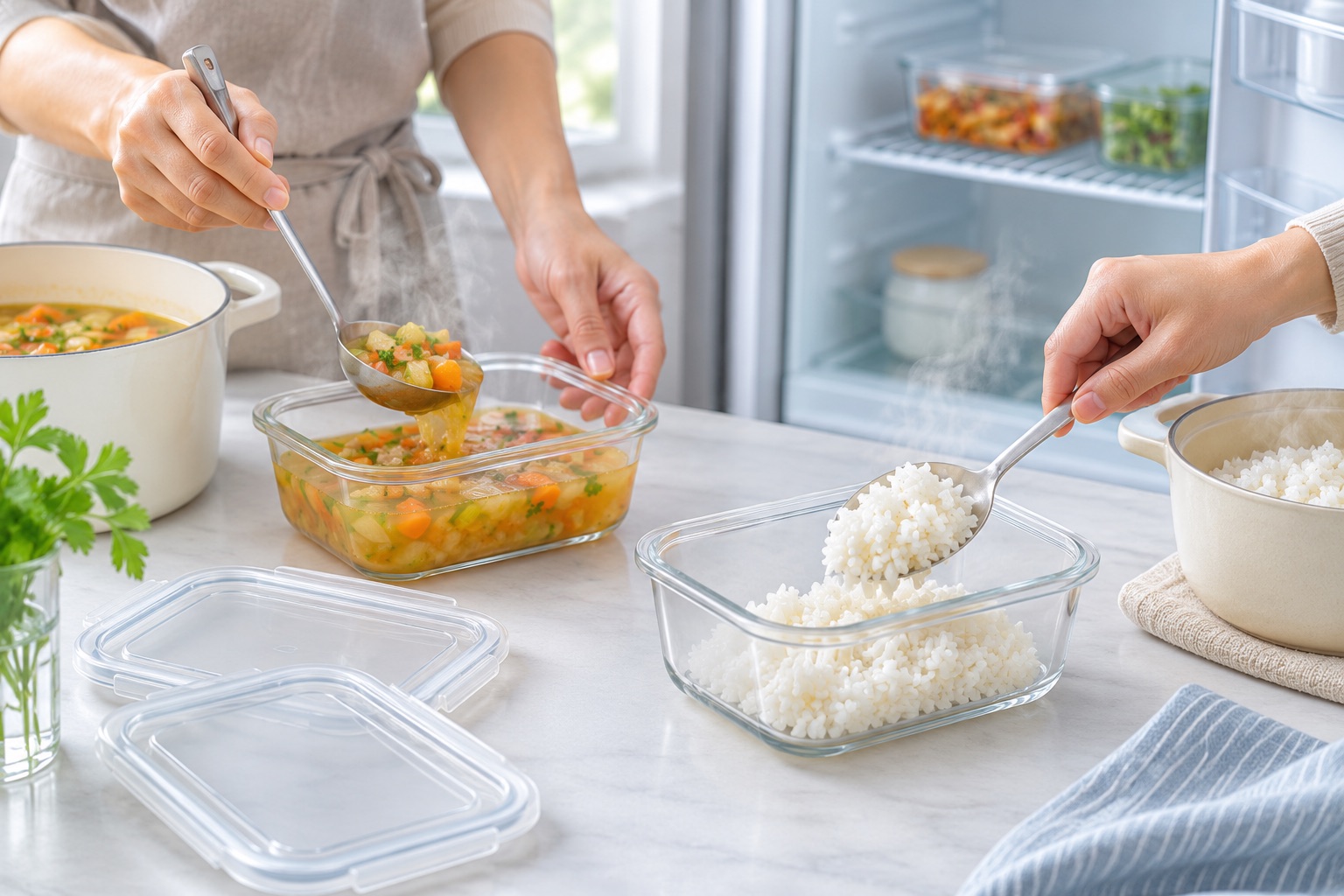
- Divide large batches. A big pot of soup or chili cools slowly in the middle. Split it into shallow containers so it reaches 40°F (4°C) quickly.
- Cut large items down. Slice roasts and hams, and take turkey or chicken meat off the bone before refrigerating.
- Wrap well. Airtight containers or tight wrapping keep bacteria out, hold in moisture and stop odors from spreading.
- Label with the date. Write the cooking date on the lid. A strip of masking tape and a marker is enough.
- Use the shelves, not the door. The door is the warmest part of the fridge. Put leftovers on an interior shelf where you will see them.
Freezing Leftovers
If you know you will not finish something within a few days, freeze it early rather than on day 4. Leftovers frozen soon after cooking taste better, and you avoid the guesswork with borderline food.
FSIS says frozen leftovers are safe indefinitely but lose moisture and flavor over time, so aim for the freezer times in the chart above. Freeze in flat bags or portion-size containers, press out the air, and label each one with the contents and date. Our guide to freezer meal prep has more on portioning.
To thaw, FSIS lists three safe methods: in the refrigerator, in cold water in a leak-proof bag, or in the microwave. Leftovers thawed in the fridge should be eaten within 3 to 4 days. You can also reheat soups, stews and casseroles straight from frozen; it just takes longer.
How to Reheat Leftovers Safely
FSIS recommends reheating leftovers to an internal temperature of 165°F (74°C), checked with a food thermometer. Bring sauces, soups and gravies to a rolling boil.
- Microwave: cover the dish, add a splash of liquid if needed, and stir or rotate halfway. Microwaves leave cold spots, so check the temperature in several places.
- Oven: cover with foil to keep food moist and heat until it reaches 165°F (74°C) throughout.
- Stovetop: best for soups, stews and sauces; stir often.
Only reheat what you will eat. FSIS says it is safe to refreeze leftovers that were reheated to 165°F (74°C), but every round of heating and cooling costs quality.
FAQ
How long do leftovers last in the fridge?
Most cooked leftovers last 3 to 4 days at 40°F (4°C) or below, according to USDA FSIS. Cooked pasta can go up to 5 days and hard-boiled eggs 1 week.
How long are pizza leftovers good for?
3 to 4 days in the refrigerator and 1 to 2 months in the freezer, per the FoodSafety.gov Cold Food Storage Chart.
Is it safe to eat pizza left out overnight?
No. Perishable food left at room temperature for more than 2 hours should be thrown away, and reheating does not destroy every toxin bacteria can produce.
Can you eat leftovers after 5 days?
It is not recommended for most foods. After 4 days the risk of bacterial growth rises, and harmful bacteria rarely change how food smells. Freeze leftovers before then if you will not eat them.
Does freezing leftovers reset the clock?
Freezing pauses it. Food is safe while frozen, and once thawed in the fridge, FSIS says to eat it within 3 to 4 days.
Keep Leftovers From Getting Lost
The 3 to 4 day rule is easy to follow when you can see what is in the fridge and when it was made. A marker on the lid works. So does logging leftovers in Freezer Inventory Tracker, which tracks your fridge as well as your freezer and sends a reminder before a container passes its window, so you can eat it or freeze it in time.