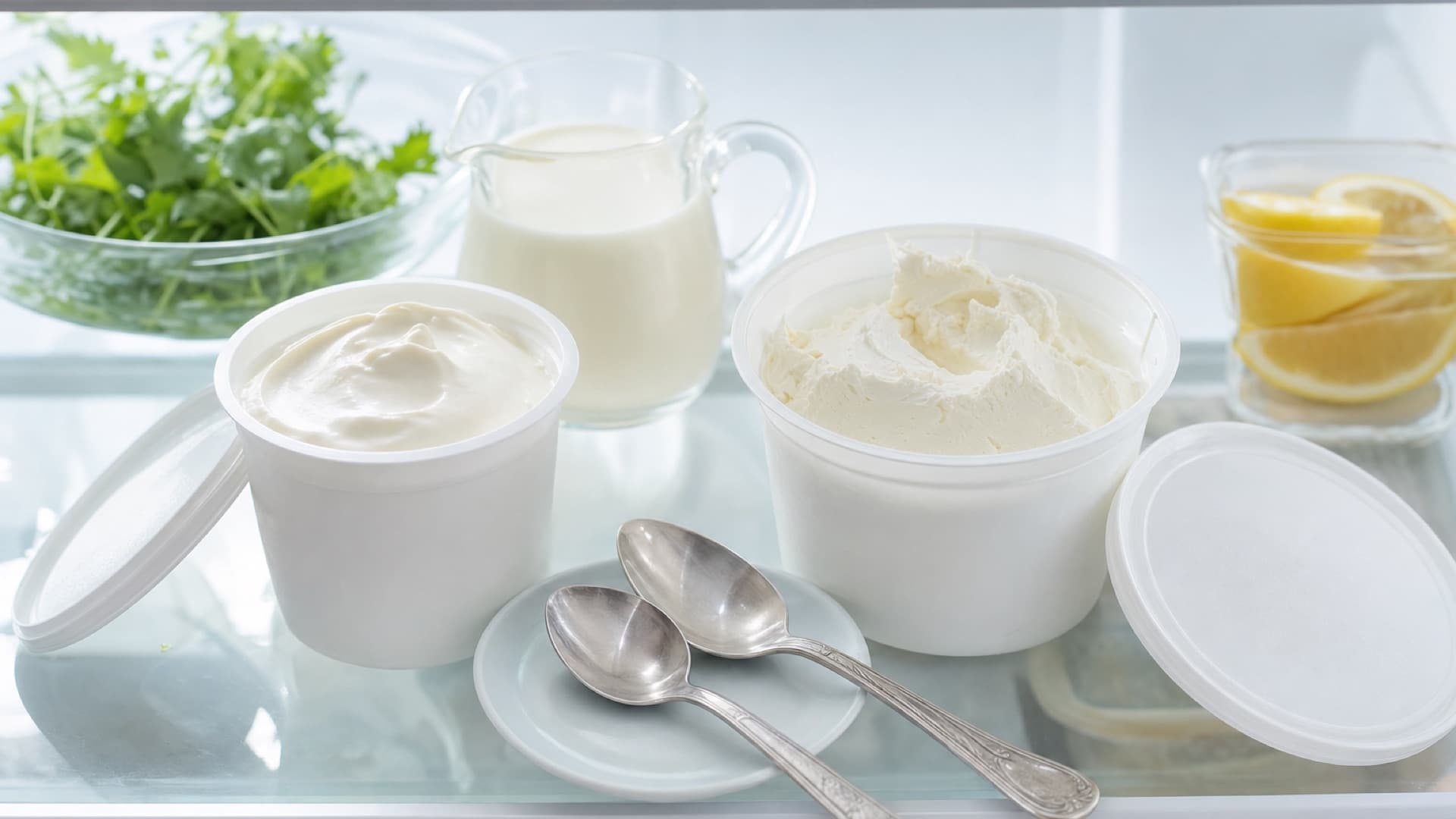
Opened sour cream is best used within about 1 to 2 weeks, and never later than the date printed on the package, as long as it stays at 40°F (4°C) or below. Opened cream cheese keeps about 2 weeks according to the USDA FoodKeeper, and opened heavy cream lasts around 10 days.
Those are the short answers. The longer answer depends on how cold your fridge is, how you scoop, and whether the tub sat on the table through a long dinner. This guide covers each product, the official numbers behind them, and how to tell when a tub has turned.
Quick Answer: Storage Times Table
The USDA FoodKeeper (developed by USDA's Food Safety and Inspection Service with Cornell University) is the main official reference for home storage times. Here is what it says, plus a practical opened-container window where the FoodKeeper only points to the package date.
| Product | Refrigerator, 40°F (4°C) | Freezer, 0°F (-18°C) |
|---|---|---|
| Sour cream | Package use-by date; once opened, aim for 1 to 2 weeks | Not recommended |
| Sour cream-based dips | 2 weeks | Not recommended |
| Cream cheese | 2 weeks | Not recommended (texture) |
| Heavy cream | 10 days | 3 to 4 months |
| Whipping cream, ultra-pasteurized | 1 month unopened, 1 week after opening | Not recommended |
| Light cream | 1 week | 3 to 4 months |
| Half and half | 3 to 4 days | 4 months |
A note on the sour cream row: the FoodKeeper does not list a separate "after opening" time for plain sour cream. It tells you to follow the package date. The 1 to 2 week opened window is a conservative rule of thumb that lines up with the FoodKeeper's 2-week figure for sour cream dips. Whichever comes first, the date or the two weeks, wins.
How Long Is Sour Cream Good After Opening?
Plan on using an opened container within 1 to 2 weeks. Sour cream is a cultured product, so it is more acidic than milk and resists spoilage a little better, but once the seal is broken it is exposed to air, mold spores and whatever is on the spoon.
What shortens that window:
- Double dipping. A spoon that touched a taco, a potato or someone's mouth carries bacteria straight into the tub. Always scoop with a clean utensil.
- Time on the table. The USDA's two-hour rule applies: perishable foods should not sit out above 40°F (4°C) for more than 2 hours, or 1 hour if it is above 90°F (32°C). A tub that spent a long nacho night on the counter should be thrown out, not returned to the fridge.
- The fridge door. Door shelves swing warmer every time you open the fridge. Keep dairy on an interior shelf.
Pro tip: Write the opening date on the lid with a marker the first time you use it. "Opened Jan 22" ends every "how old is this?" debate in two seconds.
Signs sour cream has gone bad
Throw it out if you see any of these:
- Mold of any color, even one small spot. The USDA's guidance on molds says to discard yogurt and sour cream with mold, because high-moisture foods can be contaminated below the surface, and bacteria may be growing alongside the mold.
- A sharp, yeasty or cheesy smell beyond the usual mild tang.
- Pink, yellow or gray discoloration.
- A lot of watery liquid that will not stir back in, combined with a sour off smell. (A thin layer of clear liquid on its own is just whey and is normal; stir it in.)
How Long Is Cream Cheese Good After Opening?
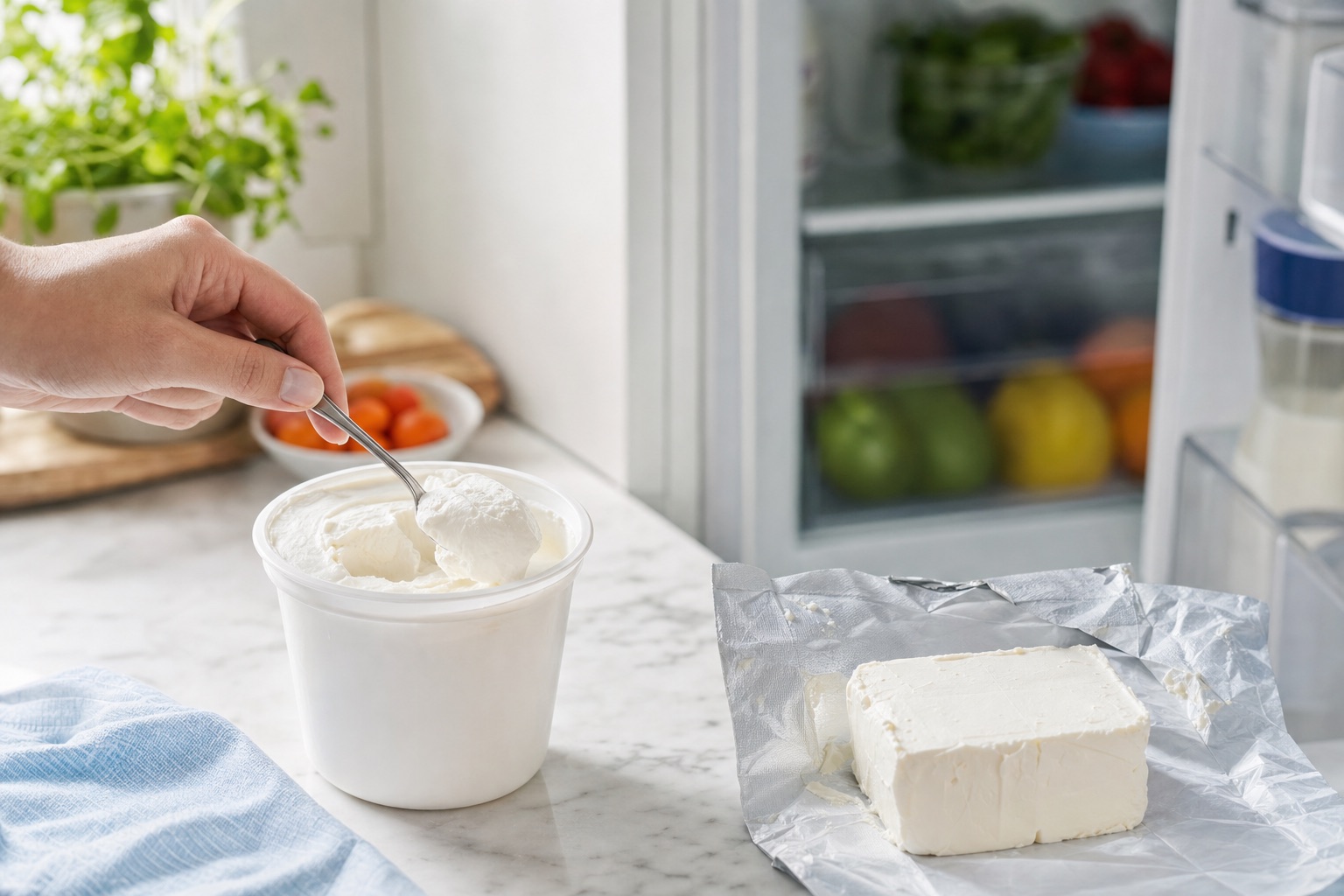
According to the USDA FoodKeeper, cream cheese keeps about 2 weeks in the refrigerator. That applies to the classic foil-wrapped blocks and to tubs of spread. Flavored spreads with mix-ins like vegetables or salmon can turn faster, so use them toward the early end of that window.
Cream cheese is a soft cheese, and that matters if you find mold. The USDA puts cream cheese in the same group as cottage cheese and ricotta: discard it if it is moldy. Unlike a hard cheese such as cheddar, you cannot cut away the moldy part, because mold threads and bacteria can spread through soft, moist cheese.
Storing cream cheese well
- Keep blocks in the original foil, then put the block in a zip-top bag or airtight container once opened.
- Press plastic wrap against the surface of a tub before closing the lid to limit air contact.
- Use a clean knife each time. Crumbs from bagels are an easy route for mold.
If you have more cream cheese than you can use in two weeks, freezing is possible for cooking and baking even though the FoodKeeper does not recommend it for quality. We cover the trade-offs in can you freeze cream cheese.
Heavy Cream After Opening
The FoodKeeper lists heavy cream at 10 days in the refrigerator and 3 to 4 months in the freezer. Most heavy cream and whipping cream sold in US supermarkets is ultra-pasteurized, which explains the long unopened dates you see on cartons. The FoodKeeper gives ultra-pasteurized whipping cream about 1 month unopened, but only about 1 week once you open it.
Signs cream has gone bad:
- Sour smell
- Lumps or curdled texture when poured
- Yellowish color or a bitter taste in coffee
Heavy cream is one of the dairy products that freezes reasonably well. It will not whip as high after thawing, but it works fine in soups, sauces and baking. Freeze it in ice cube trays or small portions so you only thaw what you need. Our guide on how to freeze butter and dairy walks through portioning and thawing.
Do Dates on Dairy Mean It Is Unsafe?
Not exactly. According to the USDA, food date labels such as "Best if Used By" and "Use By" are about quality, not safety (infant formula is the exception). A product handled properly should stay wholesome until spoilage is evident. The FDA adds that if food is clearly spoiled, abnormally soft, discolored, moldy or bad-smelling, it should be discarded regardless of the date.
For opened dairy, though, the date on the package was set assuming a sealed container. Once you open it, the clock that matters is the opened-container window in the table above. Use the earlier of the two.
For milk specifically, see how long milk is good after the expiration date.
Can You Freeze Sour Cream or Cream Cheese Instead?
The FoodKeeper does not recommend freezing either one, because both separate and turn grainy after thawing. That is a texture problem, not a safety problem. Food held constantly at 0°F (-18°C) stays safe, according to the USDA.
Where freezing works:
- Sour cream: fine for baking (muffins, quick breads, coffee cake), soups, stroganoff and casseroles. Not great as a cold topping. Details in can you freeze sour cream.
- Cream cheese: fine for cheesecake, dips that get baked, and sauces. Beat it smooth after thawing.
Thaw frozen dairy in the refrigerator, not on the counter, and use it within a few days.
Keep Your Fridge Cold Enough
Every time in this guide assumes a refrigerator at 40°F (4°C) or below, the temperature the USDA and FDA recommend. Many fridges run warmer than their dial suggests, especially when packed full or opened often. A cheap appliance thermometer on the middle shelf tells you the truth. If yours reads above 40°F, opened dairy will spoil faster than these charts say. More on settings in what temperature should a freezer be (and your fridge).
FAQ
How long is sour cream good for after opening?
About 1 to 2 weeks in a refrigerator at 40°F (4°C) or below, and not past the package date. The USDA FoodKeeper ties plain sour cream to the package date, so treat that date as your outer limit once the tub is open.
How long is cream cheese good for after opening?
About 2 weeks in the refrigerator, according to the USDA FoodKeeper. Discard it if you see mold anywhere, since cream cheese is a soft cheese and mold can spread below the surface.
How long is heavy cream good after opening?
The FoodKeeper lists heavy cream at 10 days in the fridge. Ultra-pasteurized whipping cream lasts about 1 week after opening. Smell it before using; sour odor or lumps mean it is done.
Can I scrape the mold off sour cream and eat the rest?
No. The USDA advises discarding yogurt and sour cream that show mold, because contamination can reach below what you see.
Is sour cream left out overnight safe?
No. Perishable dairy should not stay above 40°F (4°C) for more than 2 hours, or 1 hour above 90°F (32°C). Throw it out.
Keep Opened Dairy From Getting Lost
Most opened dairy is wasted for one reason: nobody remembers when it was opened. Write the date on the lid, keep tubs on a visible shelf rather than the back corner, and check them once a week. If you would rather not rely on memory, Freezer Inventory Tracker can hold your fridge items alongside your freezer and pantry, and remind you before the sour cream reaches the two-week mark.