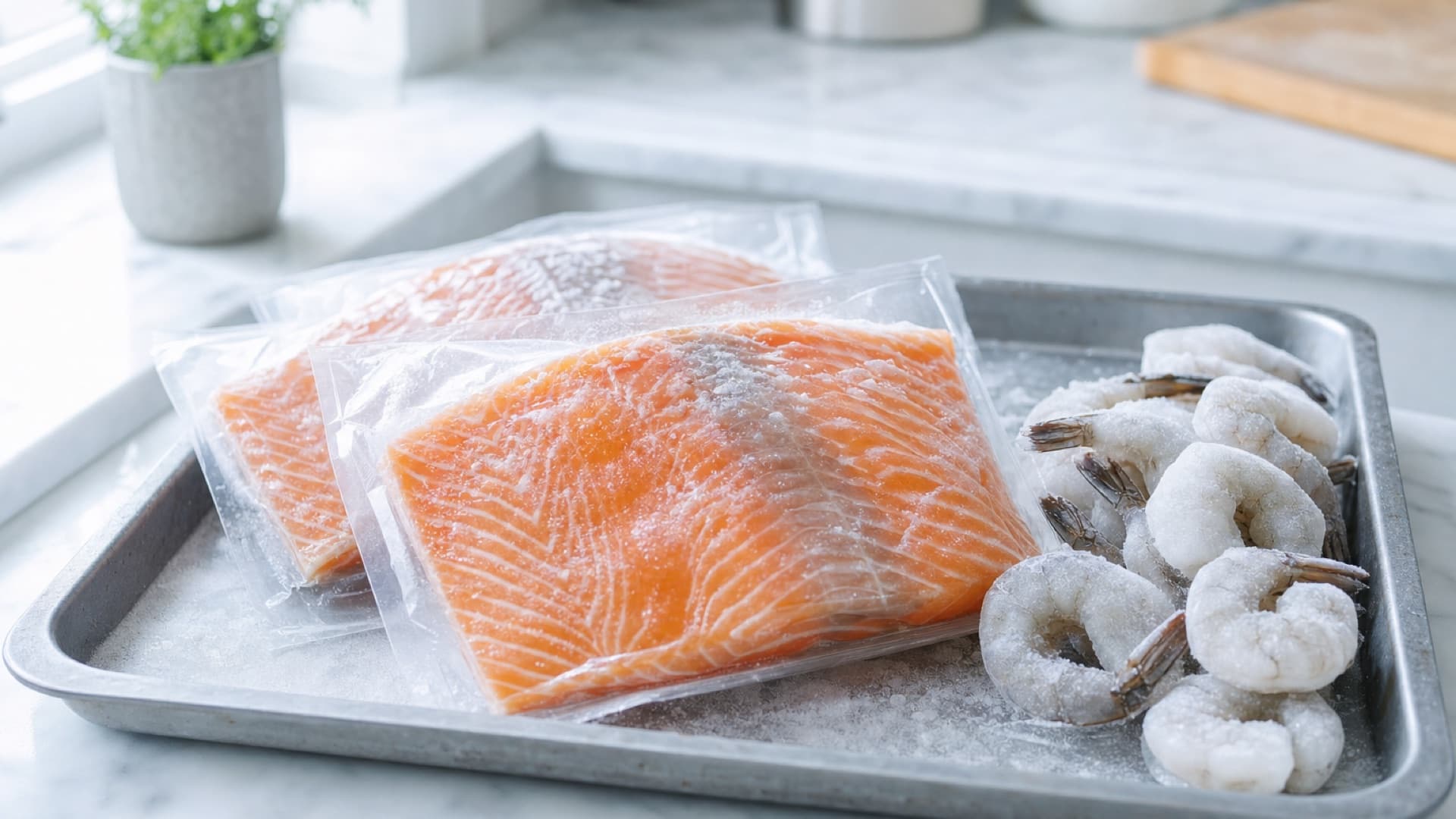
Raw salmon keeps its best quality for 2 to 3 months in a freezer at 0°F (-18°C), according to the USDA FoodKeeper and the FoodSafety.gov Cold Food Storage Chart. After that it is still safe to eat if it stayed frozen the whole time, but the flavor and texture decline noticeably.
That 2 to 3 month window is short compared with lean fish, shrimp or most meats, and the reason is fat. This guide explains why salmon has a shorter freezer life, gives storage times for other seafood, and shows how to judge salmon that has been in the freezer too long.
Freezer Storage Times for Salmon and Seafood
All times are for quality at 0°F (-18°C). The USDA notes that frozen food kept constantly at that temperature stays safe indefinitely.
| Seafood | Freezer time (best quality) |
|---|---|
| Raw salmon and other fatty fish (tuna, mackerel, catfish, bluefish) | 2 to 3 months |
| Raw lean fish (cod, flounder, haddock, halibut, sole) | 6 to 8 months |
| Raw lean fish (pollock, ocean perch, rockfish, sea trout) | 4 to 8 months |
| Cooked fish, all types | 1 to 2 months |
| Raw shrimp, crayfish, squid | 6 to 18 months |
| Commercially frozen shrimp and shellfish | 12 to 18 months |
| Cooked shellfish | 1 to 3 months |
| Fresh crab meat, fresh lobster | 2 to 4 months |
| Shucked clams, mussels, oysters, scallops | 3 to 4 months |
Sources: FoodSafety.gov Cold Food Storage Chart and USDA FoodKeeper.
Why Salmon Has a Short Freezer Life
Salmon is a fatty fish. Its fat is rich in unsaturated fatty acids, the same healthy omega-3 fats people buy salmon for, and unsaturated fats are prone to oxidation. Freezing slows that process but does not stop it, especially where air touches the fish. Over time the fat goes rancid, which shows up as a strong "fishy," bitter or stale taste and a yellowish tinge along the edges.
Lean white fish such as cod has very little fat to oxidize, which is why it lasts 6 to 8 months. That is the same reason the USDA groups salmon with tuna, mackerel and catfish in the 2 to 3 month category.
Is Frozen Salmon Safe After 3 Months?
Yes, if it has stayed frozen. The USDA is clear that freezer storage times are for quality only and that food stored constantly at 0°F (-18°C) will always be safe. Freezing keeps microbes dormant. It does not kill them, which is why thawed fish has to be handled like fresh fish.
So a salmon fillet found at month five is a quality question, not a safety question. The exception is if the freezer failed, the power went out for a long time, or the fish thawed and refroze outside the refrigerator. FoodSafety.gov advises discarding frozen fish and shellfish that thawed and were held above 40°F (4°C) for more than 2 hours.
Frozen Fish Past the Date on the Package
The date on a bag of frozen salmon or shrimp is a quality date set by the manufacturer. According to the USDA, product dates (other than on infant formula) are not safety dates, and products handled properly stay wholesome until spoilage is evident.
Commercially frozen fish is usually frozen very quickly at very low temperatures, and the packaging is designed for the freezer, so it often holds quality well. Once you open the bag, though, air gets in and the clock speeds up. Reseal opened bags tightly or move the contents into a better freezer bag.
Pro tip: Buy salmon in individually vacuum-sealed portions or wrap each fillet yourself. You thaw only what you need, and the rest stays sealed away from air.
How to Tell If Frozen Salmon Is Past Its Best
Before cooking, look for:
- Freezer burn: dry, white or grayish-brown leathery patches. The USDA says freezer burn does not make food unsafe, just dry in spots. Trim small patches before or after cooking. Heavily freezer-burned fish may not be worth cooking. More in what freezer burn is and how to prevent it.
- Heavy ice crystals inside the package. These often mean the fish partly thawed and refroze at some point, which hurts texture.
- Yellow or brown edges on the flesh, a sign of oxidized fat.
After thawing, smell it. The FDA notes spoiled seafood can smell sour, rancid, fishy or like ammonia, and that these smells get stronger after cooking. If the thawed salmon smells strongly rancid or of ammonia, discard it.
How to Freeze Salmon So It Lasts
- Freeze it fresh. The USDA notes that food frozen at peak quality comes out tasting better than food frozen near the end of its useful life. Freeze raw salmon within a day or two of buying it.
- Pat it dry. Surface moisture becomes ice crystals.
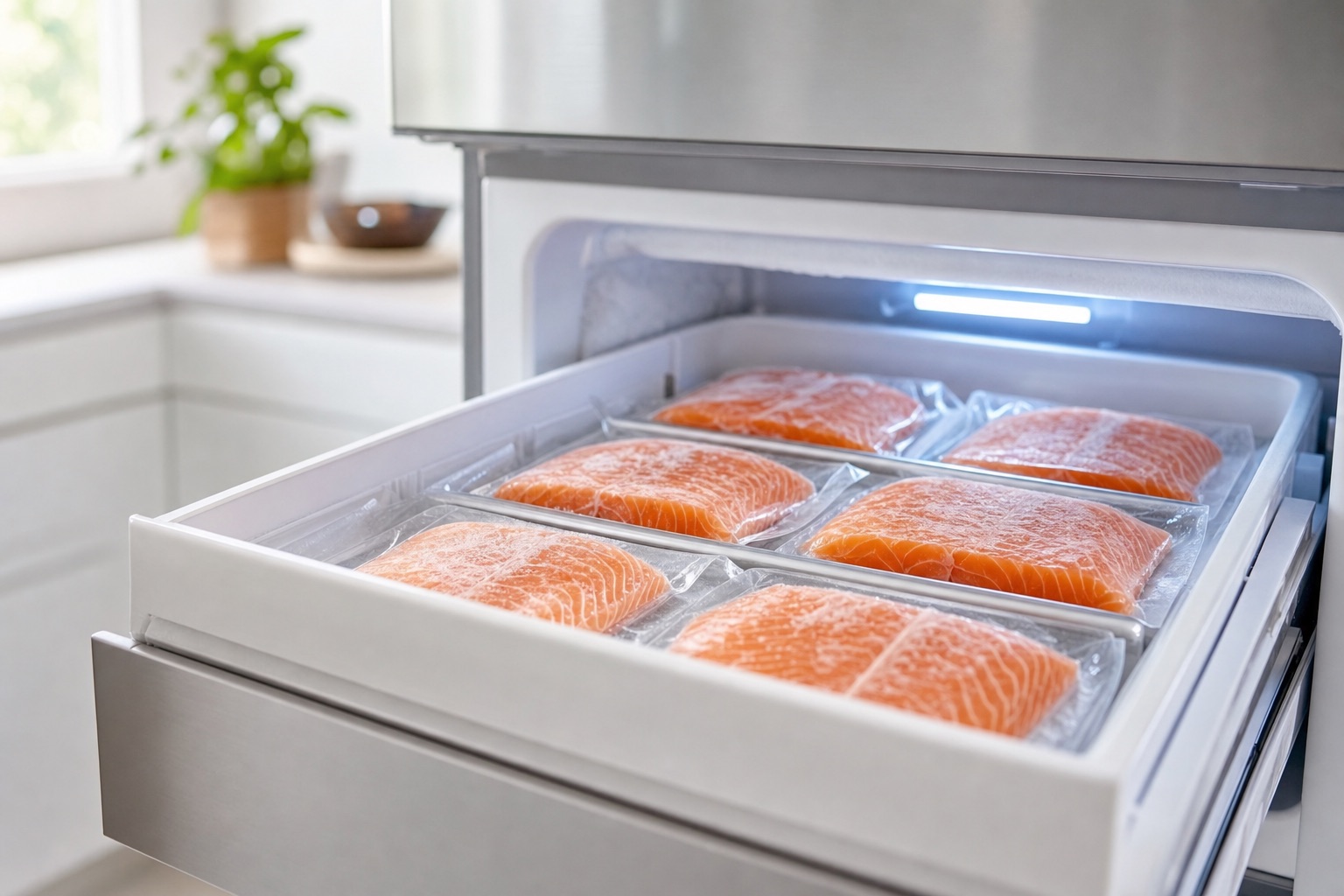
- Wrap tightly. The FDA recommends wrapping seafood tightly in plastic, foil or moisture-proof paper. Vacuum sealing is best. Otherwise wrap in plastic and then put it in a freezer bag with the air pressed out.
- Freeze flat and fast. Spread portions in a single layer until solid; the USDA notes that rapid freezing forms smaller ice crystals and protects texture.
- Label with the date. A 2 to 3 month window is only useful if you know when it started.
For step-by-step methods, including glazing fish with a thin layer of ice, see how to freeze fish and seafood.
How Long Does Frozen Shrimp Last?
Raw shrimp lasts much longer than salmon: 6 to 18 months, according to the FoodSafety.gov chart. Commercially frozen shrimp, which is usually frozen right after processing, is listed in the FoodKeeper at 12 to 18 months. Shrimp is lean, so there is little fat to go rancid.
Cooked shrimp is another story: 1 to 3 months for cooked shellfish. If you bought a frozen cooked shrimp ring, follow the package date.
Thawing Frozen Salmon
The FDA and USDA agree on three safe methods:
| Method | Approximate time | Cook when? |
|---|---|---|
| Refrigerator | Overnight; allow a full day for a 1-pound package | Within 1 to 2 days after thawing |
| Cold water (sealed bag, water changed every 30 minutes) | About 1 hour or less per 1-pound package | Immediately |
| Microwave (defrost setting, stop while still icy but pliable) | A few minutes | Immediately |
Never thaw fish on the counter or in hot water. You can also cook salmon straight from frozen; the USDA says it takes about 50 percent longer. Cook salmon to an internal temperature of 145°F (63°C), as the FDA recommends, or until the flesh is opaque and separates easily with a fork. Our guide on how to thaw shrimp and salmon goes through each method in detail.
Cooked Salmon in the Freezer
Cooked salmon keeps 1 to 2 months in the freezer, according to the FoodKeeper. It is best used in dishes where texture matters less: salmon cakes, chowder, pasta or fried rice. If it is still in the fridge, remember that cooked salmon lasts only 3 to 4 days there, so move it to the freezer early.
FAQ
How long does salmon last in the freezer?
Raw salmon keeps its best quality for 2 to 3 months at 0°F (-18°C), according to the USDA. It remains safe beyond that if it stays frozen, but the taste declines.
How long does frozen shrimp last?
Raw shrimp keeps 6 to 18 months in the freezer, and commercially frozen shrimp 12 to 18 months. Cooked shrimp is best within 1 to 3 months.
Can you eat frozen fish past the date?
Generally yes, if it stayed frozen. Dates on frozen fish are about quality, not safety, according to the USDA. Check for heavy freezer burn and a rancid smell after thawing.
Can you eat salmon that has been frozen for a year?
It should be safe if it was kept continuously at 0°F (-18°C), but expect dry texture and stronger, possibly rancid flavor. Use it in heavily seasoned dishes, or discard it if it smells off after thawing.
Can you refreeze thawed salmon?
According to the USDA, food thawed in the refrigerator can be refrozen without cooking, with some quality loss. Salmon thawed in cold water or the microwave should be cooked before refreezing.
Keep Salmon on a Short Rotation
Because salmon has one of the shortest windows in the freezer, it pays to treat it as "use soon" stock rather than long-term storage. Put new fillets behind older ones, cook the oldest first, and keep a list. Freezer Inventory Tracker does that list for you, with the freeze date on every item and a reminder when the salmon is getting close to three months. For the full picture of protein storage times, see how long meat lasts in the freezer.